Patentability Search & Analysis

Patentability

Our patentability search service helps inventors assess whether their inventions are novel and non-obvious, providing insights into the scope of potential patent protection. With over 20 years of experience, SciTech Patent Art uses advanced search techniques, including deep web research, to uncover critical information from both patent and non-patent sources. We deliver timely, cost-effective, and high-quality assessments that guide inventors in patent filing strategies, ensuring they make informed decisions about their intellectual property.

Prior art or novelty searches are also known as patentability searches. Patentability Search / Novelty Search are conducted to unearth the closest prior art, be it a patent publication or non-patent literature. In order to file a patent application for an invention, the first step is to conduct a patentability search. A patentability search determines how unique an invention is compared to existing inventions.

Patent protection is a lengthy and expensive process that involves drafting and filing a patent application, prosecution of the application at the patent office and maintenance of the patent. Though patentability search is not a mandatory process before filing a patent application, it could help an inventor avoid spending money and resources on patentable ideas that are not new.

By conducting a patentability search, an inventor can determine whether or not the technical features of the invention can be patented, as well as how the invention differs from the existing art. It will also help the inventor strategize drafting the claims in a more appropriate manner, i.e., neither too broad nor too narrow. Moreover, a patentability search will help an inventor understand the current state-of-the-art, and allow designing around existing prior art, if required.

When the inventor determines that an idea for an invention does not already exist in the art, is non-obvious to a person skilled in the art, and has industrial applicability, then a patent application may be filed.

Patentability search is the foremost step in protecting IP rights and is useful in answering questions such as the following:

We have an invention and would like to seek protection at the earliest. Can we get a patent? If so, what could be the scope of protection?

Any invention is patentable only if it is novel and non-obvious to a person skilled in the art. SciTech Patent Art has been conducting patentability searches for independent inventors, academic and research institutes, and large corporations for over a decade; and has built unique expertise in assessing the patentability of an invention. We look at both patent and other published literature before providing our assessment in a cost-effective and timely manner. Our assessment helps the inventor in deciding on the scope of the protection that could possibly be obtained.

Our Methodology for a Patentability Search:

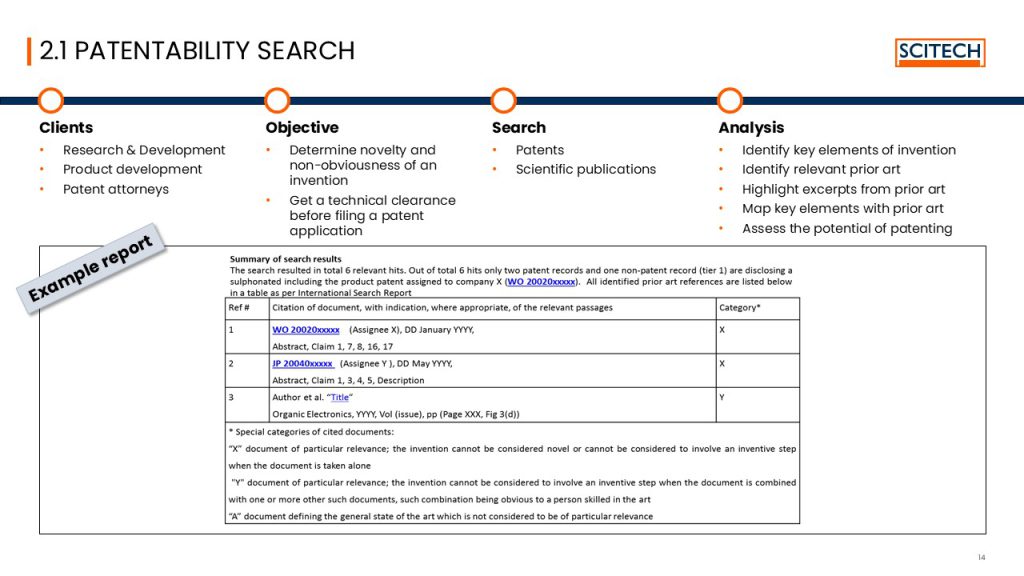
A patentability search is conducted by understanding the three key concepts – novelty, non-obviousness, and industrial applicability. At SciTech Patent Art, our analysts have been conducting patentability searches for topics from different technical domains, for over two decades. Our analysts are highly qualified subject matter experts from various technology domains, and are very familiar with the different patenting systems worldwide. They have a systematic approach towards conducting patentability search and assessment that involves:

  • Understanding the query and identifying key elements from the invention disclosure
    • Identifying key elements of the invention requires deep understanding of the technology. Our analysts have the experience and knowledge to grasp the technicalities from the invention disclosure.
    • Defining searchable concepts based on the understanding of the invention
  • Laying out a detailed search methodology that involves:
    • Identifying keywords, synonyms, spelling variations, plurals, abbreviations, etc.
    • Selecting appropriate class codes
    • Defining search or proximity operators
    • Developing search strategies and search strings using combinations of searchable concepts
  • Selecting appropriate information sources and databases to conduct the search
  • Multiple search iterations performed on various sources and database for comprehensive coverage
  • Identifying non-patent information using SciTech Patent Art’s proprietary Deep Web Search tool to uncover more information than any traditional methods of searching
  • Provide a comprehensive report with assessment of patentability

Report format of a Patentability Search:

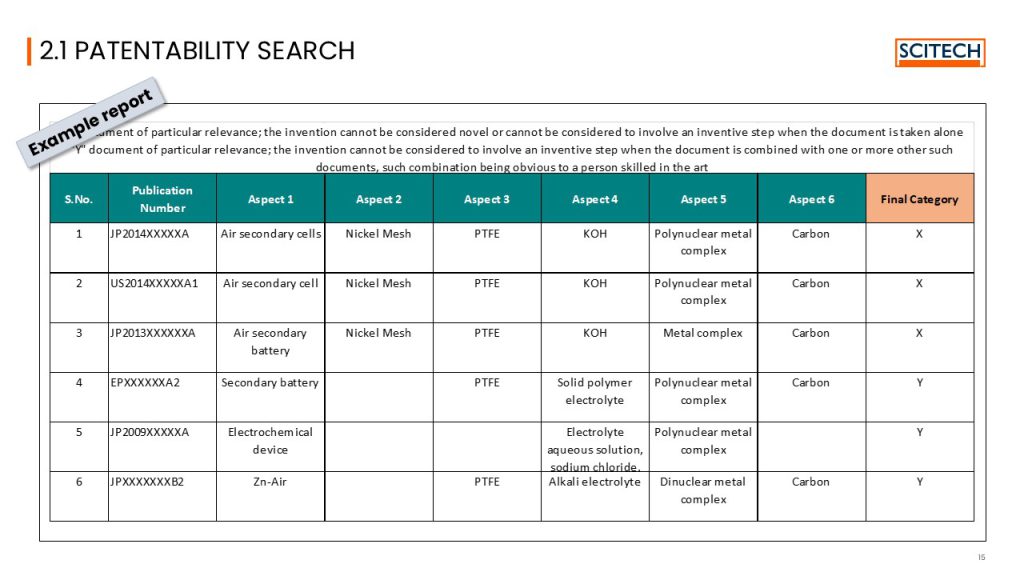
Our typical patentability assessment report is in an MS Word or MS Excel format that includes –


Patentability Search & Analysis FAQs

1. What is a patentability search?

A patentability search is a structured analysis conducted to evaluate whether an invention is likely to satisfy key patentability requirements such as novelty and inventive distinction. The process involves reviewing existing patents, published applications, and relevant technical disclosures related to the invention. Patentability searches help organizations understand the existing technology landscape before filing a patent application.

2. Why is patentability search important before filing a patent?

Patentability search is important because it helps identify existing disclosures that may affect the scope or strength of a patent application. Early analysis enables inventors and organizations to make informed filing decisions, improve drafting strategies, and reduce potential prosecution challenges. It also helps support stronger intellectual property planning and resource allocation.

3. How is a patentability search conducted?

A patentability search is generally conducted by identifying the core inventive concept, technical features, and application areas of the invention. Search strategies may include keyword searching, patent classification analysis, citation review, and evaluation of related patent and non-patent literature. Iterative refinement improves search relevance and coverage.

4. What sources are reviewed during a patentability search?

Patentability searches may involve reviewing patents, published patent applications, scientific journals, technical papers, product literature, conference proceedings, and other publicly available technical disclosures. Combining patent and non-patent literature helps improve the comprehensiveness of the analysis.

5. How does patentability analysis support patent drafting?

Patentability analysis helps strengthen patent drafting by identifying existing technologies and highlighting the inventive aspects of an invention. These insights support the preparation of stronger claims, improve technical positioning, and help align the application with the surrounding technology landscape.

6. What is the difference between patentability search and prior art search?

A prior art search broadly identifies existing disclosures related to a technology area, while a patentability search specifically evaluates whether an invention may qualify for patent protection. Patentability analysis focuses more directly on novelty, inventive distinction, and potential filing strength.

7. Why is technical expertise important in patentability analysis?

Technical expertise is important because inventions often involve specialized concepts and complex technical details. Subject matter understanding improves interpretation of disclosures, enhances search quality, and supports more accurate assessment of similarities and inventive distinctions.

8. What challenges are involved in patentability searches?

Patentability searches can involve challenges related to broad technical terminology, evolving technologies, multilingual disclosures, and large volumes of patent data. Similar inventions may also be described differently across industries and jurisdictions, requiring detailed and structured analysis.

9. How do patent classifications improve patentability searches?

Patent classifications help organize inventions into technology-specific categories, improving search precision and efficiency. Classification-based searching enables identification of relevant disclosures that may not appear through keyword searches alone, especially in highly technical fields.

10. Can patentability searches help reduce filing risks?

Yes, patentability searches help reduce filing risks by identifying existing disclosures before filing a patent application. Early-stage analysis supports better decision-making, improves drafting strategies, and helps organizations evaluate the potential strength of an invention more effectively.

11. How does patentability analysis support innovation strategy?

Patentability analysis provides visibility into existing technologies, competitor activity, and innovation trends within a technology domain. These insights help organizations identify opportunities, evaluate research direction, and align innovation activities with broader intellectual property objectives.

12. Which industries commonly use patentability searches?

Industries such as biotechnology, pharmaceuticals, electronics, materials science, telecommunications, clean technology, automotive, and medical devices commonly rely on patentability searches to support innovation assessment and patent filing activities.

13. What role does non-patent literature play in patentability analysis?

Non-patent literature plays an important role because many technical disclosures appear in scientific publications, research papers, manuals, and industry documents before patent filings occur. Including these sources improves the overall depth and quality of the patentability assessment.

14. Why is expert-driven patentability analysis valuable?

Expert-driven patentability analysis combines technical understanding with structured search methodologies to improve the accuracy and relevance of results. Detailed analysis helps organizations better evaluate invention strength, support filing decisions, and develop stronger intellectual property strategies.

Sectors

Subject Matter Expertise

Biotechnology & Pharmaceuticals
Chemical Industry
Chemical Industry
Consumer Products
Consumer Products
Electronics & Telecommunications
Food Technology
Food Technology
Materials Science
Materials Science
Mechanical Equipment
Medical Devices
Medical Devices
Oil & Gas
Oil & Gas
Packaging & Design
Packaging & Design
Searches you can rely on

We deliver high-quality, and tailored searches. We consistently uncover invalidating art for tough claims, which speaks to our search rigor.

  • Database Access

    With over 22 years of experience, we excel in searching industry-leading patent, chemical structure, technical literature, and business databases.

  • Subject matter expertise

    Backed by 20+ years of expertise across fields like chemicals, electronics, and pharmaceuticals, our team delivers unmatched, high-impact results.

  • Deep Web Research

    Our unrivaled deep web crawling sets us apart—our expert data engineers work with subject specialists to uncover and access critical, targeted information.

  • Discovery Partner

    Through close collaboration with clients, often litigating attorneys, our searchers uncover invalidating references, making us a trusted discovery partner—delivering value far beyond typical search firms.

Give us a try. Let’s get started

our approach

How we meet your need

  • your-request

    Your Request

    • Question you are trying to answer
    • Type of search or analysis
    • Turnaround time and budget constraints, if any

  • Scope-and-timing

    Scope & Timing

    • Our proposal
    • Scope understanding
    • Search / analysis strategies
    • Examples
    • Cost and turnaround

  • Results-and-dicussion

    Results & Discussion

    • Preliminary results
    • Scope adjustments, if any
    • Discussion & iteration
    • Final report timing

  • Final-report

    Final Report

    • Final report with conclusions
    • Invoice submitted

Case Studies