Patent Validity / Invalidity Search

Patent Validity / Invalidity Search

SciTech Patent Art provides comprehensive patent validity and invalidity search services to assess the strength of patents and help guide your strategic decisions. With a unique blend of human expertise and advanced AI/ML tools, we thoroughly explore both indexed and deep web sources for prior art. Our patent validity search services are backed by deep technical analysis and expert insights, ensuring high-quality results that empower you to protect your intellectual property and navigate potential litigation challenges effectively.

The purpose of a patent validity search or a patent invalidity search is to understand the strength of a patent, i.e., whether or not the patent is defendable in a court if litigation arises. Such a search is done for several reasons: to understand the strength of a patent that you are planning to acquire, to understand if a patent standing in your way is really defensible, to protect your own position in case someone has accused you of infringement, and so on. Conducting a patent invalidity analysis gives you a strategic advantage over the competition.

SciTech Patent Art’s scientists are experts in conducting patent invalidation search and validity searches. We bring both technical expertise and knowledge of databases/tools. Invalidity and validity searches require the use of experts who have extensive search experience, are familiar with patent laws, and are well-versed in technical interpretation. You can rely on our team of experts to attend to your project and assist you in finding a solution to some of the most difficult IP challenges. SciTech Patent Art has received commendations from many clients over the years for finding precise prior art. SciTech Patent Art scientists have also received accolades in global search competitions for their search skills.

Our Methodology for a Patent Validity/ Invalidity Search:

SciTech Patent Art adopts a unique and unconventional process towards patent invalidation searches that involves human experts and is powered by Deep Web & AI/ML tools. Searches for invalidity and validity are primarily concerned with finding prior art that was not retrieved by patent examiners during prosecution using conventional search techniques. In order to identify relevant prior art, various sources of information are searched, such as patents, scientific literature, product specifications, and other publicly available sources.

The conventional approach includes keyword searches, classification searches, author/inventor name searches, and citation searches. Conventional approaches that cover all data sources generally result in several references if an in-depth search is conducted.

In order to find the most compelling prior art, various sources of information are searched, such as patents, scientific literature, product specifications, and other publicly available sources.

The first step involves an analysis of preliminary search results and the searcher’s experience is used to identify pockets of information.
The next step requires to dig deeper into those pockets of information. There are, however, many unindexed or hidden pages that prevent popular search engines from digging into all the pertinent data. At this stage, the use of AI/ML and deep-web solutions is very helpful as they are very efficient at retrieving almost all the required information even from unindexed or hidden pages.

The following are the ways to identify pockets/hot-spots of information:
Identify and search for novel aspect of claims that define the underlaying invention.
Review family patents as an applicant may file patents in multiple jurisdictions of interest
Citation search of patents and non-patent literatures data
Identify specific Universities/ Institutes, companies or authors/ inventors
Comprehensive Deep Web searches with AI/ML and proprietary crawling solutions
SciTech Patent Art has a unique unconventional approach to finding compelling invalidating prior art.

An important component of patent invalidity analysis is the interpretation or analysis of the technical content of the prior art. In order to conduct a technical analysis, subject matter experts must have a thorough understanding of the technology in the prior art and be able to compare it to the claimed invention. Scientists and engineers on our team are highly qualified and well-trained and can conduct in-depth technical analyses for you.

Report format of a patent invalidity/ validity search:

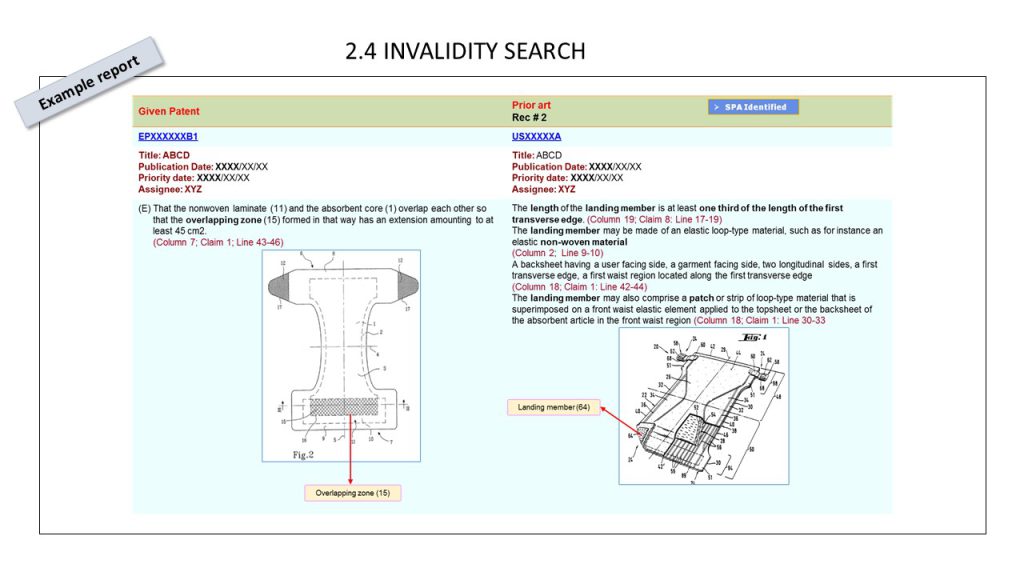
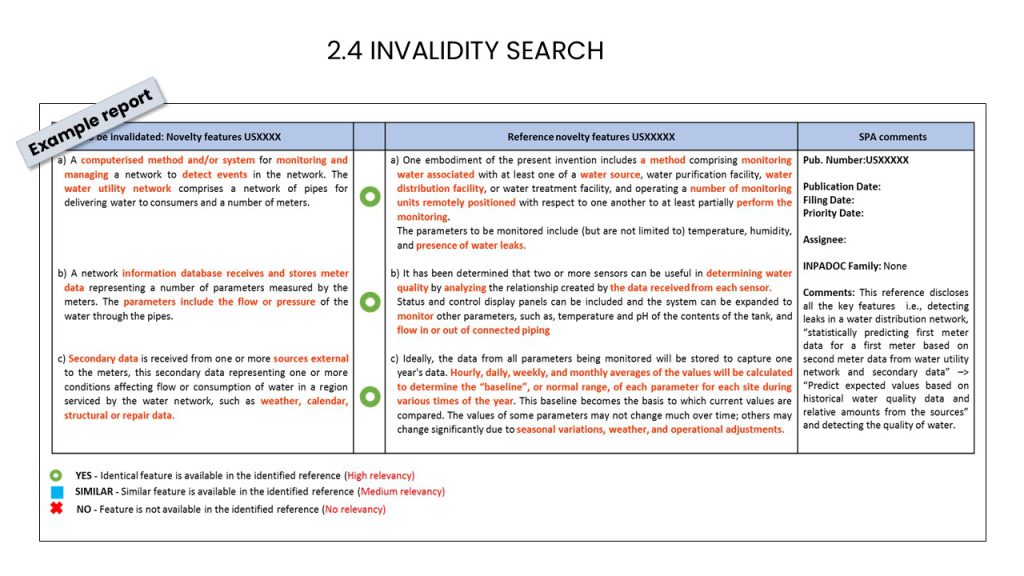
Our typical patent invalidity search report is in a Word or PowerPoint format that includes:

Project methodology

Outlines the key subject matter of the search and the earliest priority date

Relevant patents

Summary of key prior art references identified in a tabular format
Details of each prior art reference with respect to the technical features highlighted for various sections of the patent document
In addition, technical opinion of our analyst for each of the prior art reference

Search details

Includes the date of search, search period, sources used for the search, keywords, classification codes, citation search and inventor search details included.
Patent Validity / Invalidity Search FAQs

1. What is a patent validity search?

A patent validity search investigates whether a granted patent’s claims would hold up under legal challenge, by locating prior art that a patent examiner may have missed during prosecution. It covers patents, scientific literature, product specifications, and other publicly available sources to assess how defensible the claims truly are. SciTech Patent Art conducts patent validity searches using both conventional methods and AI/ML-powered deep web tools to surface even the most obscure prior art.

2. What is patent invalidity?

Patent invalidity refers to the legal conclusion that a granted patent — or specific claims within it — should not have been granted because the invention lacked novelty, inventive step, or failed to meet other patentability criteria at the time of filing. A patent can be challenged as invalid through inter partes review (IPR), post-grant review (PGR), opposition proceedings, or litigation. An invalidity search is the foundational step in building that case.

3. What is patent invalidation?

Patent invalidation is the process of using prior art evidence to demonstrate that a granted patent’s claims are legally unenforceable, effectively canceling or narrowing those claims through a formal challenge before a patent office or court. A thorough patent invalidation search looks beyond standard patent databases to uncover product literature, academic publications, conference proceedings, and deep web sources that standard examiners may never have reviewed. SciTech Patent Art specializes in uncovering this kind of compelling, non-obvious prior art.

4. What is a patent invalidity search?

A patent invalidity search is a targeted prior art investigation conducted to find evidence that a specific patent’s claims lack novelty or inventive step, covering patents, non-patent literature, product manuals, standards documents, and deep web sources. Unlike a patentability search — which is forward-looking and done before filing — an invalidity search is backward-looking, focused on what existed publicly before the patent’s priority date. SciTech Patent Art delivers invalidity search reports in Word or PowerPoint format with detailed claim-mapping and analyst commentary.

5. How to invalidate a patent?

Invalidating a patent typically starts with a thorough invalidity search to identify prior art that anticipates or renders obvious one or more of the patent’s claims. Once compelling prior art is found, it can be used to challenge the patent through IPR or post-grant review at the USPTO, opposition proceedings at the EPO, or as a defense in infringement litigation. SciTech Patent Art’s deep web and AI-assisted search approach is designed to surface the strongest possible invalidating references for each specific claim.

6. How to invalidate a patent application?

A published but not yet granted patent application can be challenged through pre-issuance submissions at the USPTO, which allow third parties to submit prior art for the examiner’s consideration before the patent issues. Third-party observations serve a similar function at the EPO, and the earlier a challenge is mounted, the less expensive and more effective it tends to be compared to a post-grant challenge. SciTech Patent Art can conduct prior art searches timed specifically to support pre-issuance submissions or opposition filings against pending applications.

7. What is the difference between a patent validity search and a patent invalidity search?

Both terms describe the same type of prior art investigation approached from different perspectives — a validity search is commissioned by a patent owner or acquirer wanting to confirm how defensible a patent is, while an invalidity search is commissioned by a challenger wanting to find prior art to contest specific claims. The search methodology covering patents, non-patent literature, and deep web sources is essentially the same in both cases; only the purpose and how the results are used differs. SciTech Patent Art conducts both, tailored to the strategic objective of each client.

8. What sources are covered in a patent invalidity analysis?

A thorough patent invalidity analysis goes well beyond standard patent databases, covering peer-reviewed scientific literature, conference proceedings, product specifications, technical standards, textbooks, and deep web or unindexed sources that conventional search engines cannot access. Citation searches, inventor/author name searches, and classification-based searches are layered on top of keyword searches to ensure nothing relevant is missed. SciTech Patent Art’s AI/ML tools and proprietary deep web crawling solutions are deployed specifically to surface prior art in hidden or difficult-to-index repositories.

9. When should a company conduct a patent validity search?

A patent validity search is most valuable before acquiring or licensing a patent, when evaluating your own portfolio ahead of assertion, or when a competitor has asserted a patent against you and you need to build a defense. It is also a standard component of due diligence for mergers, acquisitions, or investment decisions where a patent portfolio’s value is a key factor. Running a validity search early — before significant legal fees accumulate — allows companies to make informed decisions about whether to challenge, design around, or negotiate with a patent holder.

10. How long does a patent invalidity search take?

A focused single-patent invalidity search typically takes between 2 and 4 weeks, depending on the number of claims being analyzed, the technology area, and the scope of databases to be covered. More complex searches involving multiple patents or extensive non-patent literature can take longer. SciTech Patent Art works closely with clients on tight litigation deadlines and can adjust scope and resources to meet specific turnaround requirements without compromising search depth.

11. What does a patent invalidity search report include?

SciTech Patent Art’s invalidity search report is delivered in Word or PowerPoint format and includes three core sections: project methodology (key subject matter and earliest priority date), relevant prior art (a tabular summary of key references, detailed claim-feature mapping, and the analyst’s technical opinion), and search details (databases used, keywords, classification codes, citation search, and inventor search details). The report is structured to be directly usable by legal teams preparing for IPR filings, oppositions, or litigation defense.

12. What is the difference between IPR and a patent invalidity search?

An inter partes review (IPR) is a formal legal proceeding before the USPTO’s Patent Trial and Appeal Board (PTAB) in which a petitioner challenges a granted patent’s claims based on prior art. A patent invalidity search is the research process that precedes and supports an IPR petition — it is what identifies the prior art the IPR is built around. SciTech Patent Art conducts invalidity searches specifically tailored to support IPR petitions, opposition filings, and litigation briefs.

13. Can a validity search support patent acquisition or M&A due diligence?

Yes — a patent validity search is a standard component of IP due diligence for acquisitions, mergers, and licensing transactions, identifying whether the patents being acquired are genuinely enforceable or carry hidden vulnerability to invalidity challenges. A portfolio that looks strong on paper can look very different after a thorough validity search surfaces overlooked prior art, directly affecting commercial value and risk profile. SciTech Patent Art has supported clients across multiple industries with validity searches in the context of acquisitions and portfolio evaluations.

14. How does deep web research strengthen a patent invalidation search?

Many of the most compelling pieces of prior art — older product manuals, conference presentations, grey literature, and technical specifications — exist on unindexed or difficult-to-access pages that standard search engines and patent databases simply don’t surface. SciTech Patent Art’s deep web research capability uses AI/ML tools and proprietary crawling solutions to reach these hidden repositories and retrieve prior art that conventional searches consistently miss. This is one of the key differentiators in SciTech Patent Art’s invalidation search methodology, and often where the most decisive invalidating references are found.

Sectors

Subject Matter Expertise

Biotechnology & Pharmaceuticals
Chemical Industry
Chemical Industry
Consumer Products
Consumer Products
Electronics & Telecommunications
Food Technology
Food Technology
Materials Science
Materials Science
Mechanical Equipment
Medical Devices
Medical Devices
Oil & Gas
Oil & Gas
Packaging & Design
Packaging & Design
Searches you can rely on

We deliver high-quality, and tailored searches. We consistently uncover invalidating art for tough claims, which speaks to our search rigor.

  • Database Access

    With over 22 years of experience, we excel in searching industry-leading patent, chemical structure, technical literature, and business databases.

  • Subject matter expertise

    Backed by 20+ years of expertise across fields like chemicals, electronics, and pharmaceuticals, our team delivers unmatched, high-impact results.

  • Deep Web Research

    Our unrivaled deep web crawling sets us apart—our expert data engineers work with subject specialists to uncover and access critical, targeted information.

  • Discovery Partner

    Through close collaboration with clients, often litigating attorneys, our searchers uncover invalidating references, making us a trusted discovery partner—delivering value far beyond typical search firms.

Give us a try. Let’s get started

our approach

How we meet your need

  • your-request

    Your Request

    • Question you are trying to answer
    • Type of search or analysis
    • Turnaround time and budget constraints, if any

  • Scope-and-timing

    Scope & Timing

    • Our proposal
    • Scope understanding
    • Search / analysis strategies
    • Examples
    • Cost and turnaround

  • Results-and-dicussion

    Results & Discussion

    • Preliminary results
    • Scope adjustments, if any
    • Discussion & iteration
    • Final report timing

  • Final-report

    Final Report

    • Final report with conclusions
    • Invoice submitted

Case Studies