PTAB / Litigation Summary Services

PTAB / Litigation Summaries

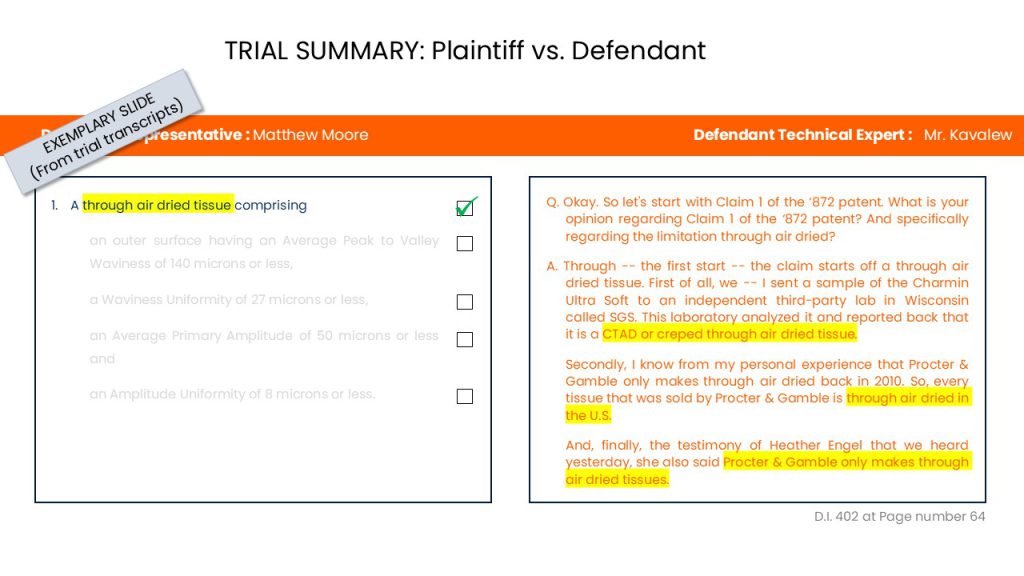
SciTech Patent Art delivers concise, insightful PTAB / patent litigation summaries tailored for legal and IP professionals. Our experts distill complex PTAB proceedings and case data into actionable patent litigation intelligence, highlighting key trends, legal arguments, and outcomes. We go beyond surface-level reporting by providing context-rich PTAB decision summaries that support strategic decisions in patent disputes. Whether it’s tracking competitor litigation through PTAB case tracking or preparing for patent trial and appeal board proceedings, clients count on us for clarity, speed, and precision in every summary.

PTAB / Litigation Summaries: Making Complex Cases Accessible

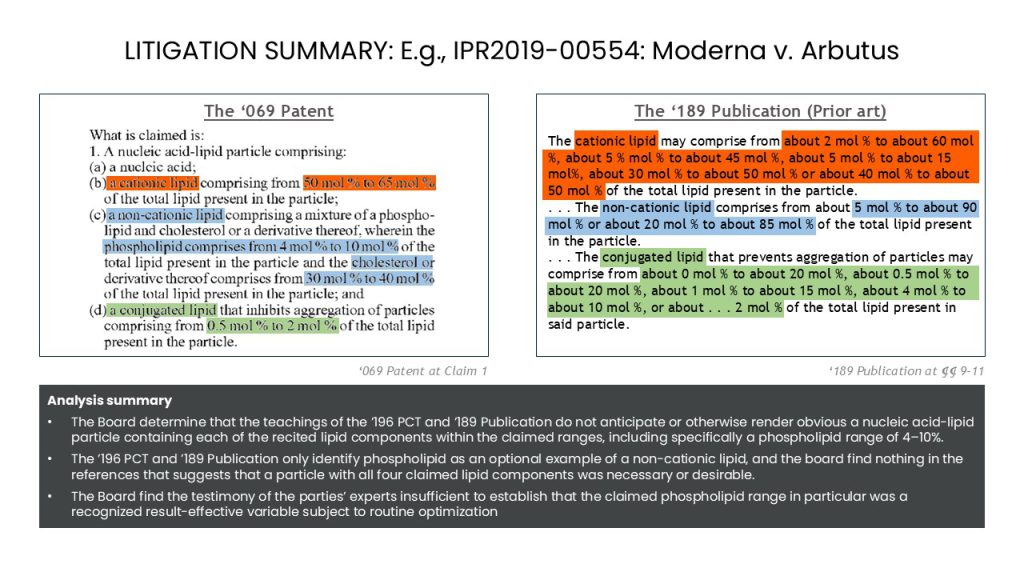
PTAB litigation summaries and patent litigation summaries provide a concise and clear overview of complex legal proceedings, making critical details accessible to judges, attorneys, and stakeholders. These patent dispute summaries distill vast amounts of information — including arguments, prior art, and PTAB decision summaries — into a streamlined, easy-to-follow format. Designed for efficiency and precision, they highlight the key elements of a case, ensuring that the most important points are communicated effectively. With a focus on clarity, PTAB litigation summaries simplify complex disputes, enabling better decision-making and fostering a deeper understanding of the case at hand. They are essential tools for navigating PTAB inter partes review challenges and litigation processes.

How SciTech Patent Art Delivers PTAB Case Tracking & Intelligence

SciTech Patent Art’s PTAB case tracking service monitors active and recently concluded PTAB proceedings across technology domains relevant to each client’s competitive landscape — surfacing IPR petition summary data, institution decisions, final written decisions, and appeal outcomes in a structured, digestible format. Our analysts go beyond pulling raw docket data by adding interpretive commentary that explains what each patent trial and appeal board decision means strategically for the client’s own patent portfolio or litigation position. This combination of patent litigation intelligence and contextual analysis is what allows legal teams and IP strategists to act on PTAB decision summaries immediately rather than spending additional time interpreting the raw legal record themselves.
PTAB / Litigation Summary Service FAQs

1. What are PTAB litigation summaries?

PTAB litigation summaries are concise, structured overviews of proceedings before the Patent Trial and Appeal Board. covering inter partes reviews, post-grant reviews, and covered business method reviews. that distill the key arguments, evidence, and decisions into a format that legal teams and IP professionals can act on quickly. They eliminate the need to read through lengthy official dockets and legal briefs by presenting only the strategically relevant elements of each proceeding in clear, accessible language. SciTech Patent Art delivers PTAB litigation summaries with interpretive commentary that explains what each decision means for the client’s specific patent portfolio or competitive landscape.

2. What is PTAB and what does it do?

The Patent Trial and Appeal Board is an administrative tribunal within the USPTO that hears and decides challenges to the validity of granted patents through formal post-grant proceedings initiated by third-party petitioners. It was created to provide a faster and more technically rigorous forum for resolving patent validity disputes than traditional district court litigation, with decisions made by panels of legally and technically trained judges. PTAB outcomes carry significant commercial weight because a decision cancelling or narrowing patent claims can immediately affect licensing negotiations, portfolio valuations, and litigation strategies across an entire technology sector.

3. What is inter partes review (IPR) and how does it relate to PTAB?

Inter partes review is a formal post-grant challenge mechanism before the Patent Trial and Appeal Board where a third party contests the validity of one or more granted patent claims by presenting evidence that the invention was not new or was obvious at the time of filing. If the PTAB decides to institute the petition, the proceeding advances to a trial phase involving written submissions, expert testimony, and oral arguments before a three-judge panel. SciTech Patent Art prepares IPR petition summaries and monitors IPR proceedings across technology domains, giving clients a clear picture of how comparable challenges have been decided and what the outcomes mean for their own patent position.

4. What is an IPR petition summary?

An IPR petition summary distills the key elements of an inter partes review petition. the challenged claims, the grounds asserted, the petitioner’s arguments, and the patent owner’s preliminary response. into a concise, structured format that gives IP and legal teams an immediate understanding of the proceeding’s scope and likely direction. Reading a full IPR petition and its accompanying exhibits can take many hours, so a well-prepared summary significantly reduces the time required to assess the relevance of a proceeding to a client’s own portfolio. SciTech Patent Art produces IPR petition summaries as part of its broader PTAB case tracking and patent litigation intelligence service.

5. What are patent dispute summaries?

Patent dispute summaries are structured overviews of patent litigation proceedings. covering complaints filed, claim construction rulings, invalidity and infringement findings, damages awards, and settlement outcomes. that give IP teams and legal advisors a clear picture of how specific patents have been treated in adversarial contexts. They are used to assess the litigation history of patents being considered for acquisition or licensing, to monitor competitor litigation activity, and to identify strategic patterns in how courts have interpreted particular claim types or technology areas. SciTech Patent Art produces patent dispute summaries across district court and PTAB proceedings for clients who need litigation intelligence without the time investment of reviewing full case records.

6. What is PTAB case tracking?

PTAB case tracking is the ongoing monitoring of active and concluded PTAB proceedings. including petition filings, institution decisions, trial schedules, final written decisions, and Federal Circuit appeals. across a defined set of patents, technology areas, or company names. It keeps IP teams informed of validity challenges that could affect the enforceability of patents they own, license, or are considering acquiring, as well as challenges to competitor patents that could open up previously protected technology areas. SciTech Patent Art’s PTAB case tracking service delivers structured updates with interpretive commentary so clients receive actionable intelligence rather than unprocessed docket data.

7. What is a PTAB decision summary?

A PTAB decision summary distills the outcome of a Patent Trial and Appeal Board proceeding. whether an institution decision, a final written decision, or a Federal Circuit appeal outcome. into a concise document that explains which claims were challenged, what the board decided, and what the decision means strategically for the relevant patent and the broader technology landscape. These summaries are particularly valuable for portfolio managers who need to stay informed about PTAB outcomes affecting their own or competitors’ patents without reading full board decisions that can run to dozens of pages. SciTech Patent Art’s PTAB decision summaries include contextual analysis that goes beyond reciting the outcome to explain the strategic implications for each client’s specific situation.

8. How does patent litigation intelligence support IP strategy?

Patent litigation intelligence encompassing PTAB decisions, district court outcomes, settlement patterns, and damages awards across a technology domain gives IP strategists a factual basis for assessing the strength of their own patents, the litigation risk posed by competitor assertions, and the likely cost and outcome of enforcement or defense in specific jurisdictions. Without this intelligence, patent strategy decisions are made on incomplete information, which increases the risk of costly surprises during licensing negotiations or litigation. SciTech Patent Art’s patent litigation intelligence service synthesizes PTAB and district court data into structured, client-specific summaries that support more informed and confident IP strategy decisions.

9. What sets PTAB proceedings apart from district court patent litigation?

PTAB proceedings are administrative in nature — handled by technically trained judges within the USPTO who evaluate whether granted patent claims should remain valid, without any authority to award damages or issue injunctions against an accused infringer. District court litigation operates in an entirely different arena, where juries or judges weigh both infringement and validity simultaneously and can impose financial remedies, permanent injunctions, and attorney fee sanctions that PTAB simply has no power to grant. SciTech Patent Art monitors and summarizes both forums so clients always have a complete, current picture of how their patents or competitors’ patents are being challenged across every relevant legal venue.

10. What roles do PTAB summaries play in patent licensing discussions?

Before entering a licensing negotiation, knowing whether the patents at the center of the discussion have faced PTAB scrutiny — and how they fared — fundamentally changes how both parties should approach the conversation about value and risk. A patent that has emerged from an instituted IPR with all claims intact carries a very different licensing posture than one with pending petitions or prior claim cancellations, and SciTech Patent Art’s summaries make that distinction clear and immediately usable. Rather than relying on either party’s framing of the patent’s strength, licensing teams gain access to an objective procedural record that grounds the negotiation in verified outcomes.

11. How does post-grant review differ from inter partes review at the PTAB?

Post-grant review gives challengers a nine-month window immediately following patent grant to raise virtually any validity argument — including those based on subject matter eligibility, enablement, and written description — making it the broadest but most time-sensitive of the two primary PTAB challenge mechanisms. Inter partes review becomes available once that window closes and is confined to validity arguments supported by prior art in the form of earlier patents or published materials, making it narrower in ground but available for the life of the patent. SciTech Patent Art’s PTAB case tracking covers both proceedings, ensuring clients are notified of any challenge filed through either mechanism that could affect a patent relevant to their portfolio or competitive position.

12. In what ways does PTAB case tracking strengthen portfolio management decisions?

Patent portfolios do not exist in a static environment — PTAB petitions filed by competitors, customers, or litigation defendants can materially change the enforceability of key assets within weeks of institution, and portfolio managers who learn of these changes late are left reacting rather than planning. SciTech Patent Art’s case tracking service eliminates this blind spot by delivering regular, structured updates on all proceedings relevant to a client’s defined patent set, with enough interpretive commentary to make the implications of each development immediately clear. The result is a portfolio management function that responds to PTAB activity proactively rather than discovering consequential decisions only after they have already affected licensing or enforcement plans.

13. How do litigation summaries contribute to IP due diligence in acquisitions?

An acquisition that places significant value on a patent portfolio requires a clear-eyed assessment of how those assets have actually performed when tested not just how they appear on paper and litigation summaries provide exactly that by documenting how courts and the PTAB have treated each patent in adversarial settings. SciTech Patent Art structures its litigation summaries for due diligence use specifically, presenting proceeding outcomes, claim scope changes, and appeal results in a format that deal teams can navigate efficiently under the time pressure of a live transaction. Buyers who incorporate this intelligence early in the process are better positioned to negotiate terms that accurately reflect the portfolio’s true enforceability rather than its face value.

14. What makes SciTech Patent Art the right partner for PTAB and litigation summary services?

What distinguishes SciTech Patent Art in this space is the combination of procedural familiarity with PTAB and district court processes and genuine technical depth across the technology domains where those proceedings most frequently arise — meaning summaries reflect both what the record says and what it means for clients operating in that specific field. Every summary is prepared by analysts who understand the technology behind the claims being contested, not just the legal procedural steps, which is what allows SciTech Patent Art to deliver interpretation alongside information rather than raw docket output that clients must decode themselves. Organizations that have worked with document-only monitoring services consistently find that SciTech Patent Art’s commentary layer is what makes the difference between intelligence they can act on and data they still have to analyze.

Sectors

Subject Matter Expertise

Biotechnology & Pharmaceuticals
Chemical Industry
Chemical Industry
Consumer Products
Consumer Products
Electronics & Telecommunications
Food Technology
Food Technology
Materials Science
Materials Science
Mechanical Equipment
Medical Devices
Medical Devices
Oil & Gas
Oil & Gas
Packaging & Design
Packaging & Design
Searches you can rely on

We deliver high-quality, and tailored searches. We consistently uncover invalidating art for tough claims, which speaks to our search rigor.

  • Database Access

    With over 22 years of experience, we excel in searching industry-leading patent, chemical structure, technical literature, and business databases.

  • Subject matter expertise

    Backed by 20+ years of expertise across fields like chemicals, electronics, and pharmaceuticals, our team delivers unmatched, high-impact results.

  • Deep Web Research

    Our unrivaled deep web crawling sets us apart—our expert data engineers work with subject specialists to uncover and access critical, targeted information.

  • Discovery Partner

    Through close collaboration with clients, often litigating attorneys, our searchers uncover invalidating references, making us a trusted discovery partner—delivering value far beyond typical search firms.

Give us a try. Let’s get started

our approach

How we meet your need

  • your-request

    Your Request

    • Question you are trying to answer
    • Type of search or analysis
    • Turnaround time and budget constraints, if any

  • Scope-and-timing

    Scope & Timing

    • Our proposal
    • Scope understanding
    • Search / analysis strategies
    • Examples
    • Cost and turnaround

  • Results-and-dicussion

    Results & Discussion

    • Preliminary results
    • Scope adjustments, if any
    • Discussion & iteration
    • Final report timing

  • Final-report

    Final Report

    • Final report with conclusions
    • Invoice submitted

Case Studies